
How to Choose the Back Brace for Your Condition
Back pain is one of the most common reasons people seek medical help, and for many, a back brace, or orthosis, plays a critical role in recovery, pain management, and stabilization. However, the world of back braces can be complex, spanning everything from soft lumbar supports to rigid custom-molded devices. Choosing the right brace is not a matter of guesswork; it requires understanding the specific area of your spine that needs support and the type of movement restriction required for your condition.
This guide breaks down the different types of spinal orthoses—including the specialized products available from Orthoneva—to help you and your healthcare provider make the most informed choice.
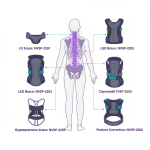
1. Braces for the Lower Back (Lumbar and Sacral Regions)
The lower back is the primary zone for lifting, twisting, and supporting the body’s weight, making it highly susceptible to strain, disc issues, and chronic pain. Braces targeting this area provide compression and limit range of motion to promote healing and reduce muscle strain.
LO Brace: NVSP-2201 (Lumbar Orthosis)
The NVSP-2201 LO Brace provides gentle compression and postural support for acute low back pain.
The LO Brace (Lumbar Orthosis) targets the middle to lower part of the lumbar spine. These braces typically offer compression and gentle support, often featuring flexible stays or panels that contour to the back.
Best suited for: Acute low back pain (lumbago), chronic muscle spasms, simple lumbar strains, or mild degenerative disc disease.
Primary function: Provides postural support, reminds the wearer to maintain proper form, and offers therapeutic warmth and compression to ease muscle tension.
LSO Brace: NVSP-2202 (Lumbosacral Orthosis)
The NVSP-2202 LSO Brace provides semi-rigid stability for the lower back and sacrum.
The LSO Brace (Lumbosacral Orthosis) extends its support further down to the sacrum (the base of the spine). These braces are generally more restrictive than the LO brace, often featuring semi-rigid panels or rigid molded inserts to stabilize the connection between the lumbar spine and the pelvis.
Best suited for: Moderate to severe lumbar instability, post-operative support following lumbar surgery, severe degenerative disc disease, or non-displaced spinal fractures in the low back.
Primary function: Significantly limits movement in the sagittal (forward/backward) and coronal (side-to-side) planes to protect healing structures.
2. Braces for the Upper Back (Thoracic and Lumbar Regions)
When a condition requires immobilization of the upper spine (thoracic region) in addition to the lower back, a Thoracolumbosacral Orthosis (TLSO) is necessary. These are often used for fracture management, post-fusion stabilization, or scoliosis.
Clamshell TLSO: NVSP-2203
The NVSP-2203 Clamshell TLSO offers maximum, total-contact support for the entire torso.
The Clamshell TLSO is a highly rigid, custom-molded (or custom-fitted) brace that encompasses the torso like a shell, providing maximum support. It typically consists of an anterior (front) shell and a posterior (back) shell that fasten together securely.
Best suited for: Comprehensive immobilization required after complex spinal fusion surgery, certain stable thoracic or lumbar fractures, or severe postural deformities that require aggressive correction.
Primary function: Provides total contact support to immobilize the thoracic and lumbar spine, preventing motion in all directions.
Thoracolumbosacral Orthosis (TLSO): 2204
The 2204 TLSO uses a three-point pressure system to stabilize the thoracic and lumbar regions, limiting flexion.
The traditional Thoracolumbosacral Orthosis (TLSO), while still highly stabilizing, may not be as encompassing as a Clamshell design but still covers the full thoracic and lumbar regions. These are designed to provide three-point pressure stabilization to limit flexion and extension.
Best suited for: Stable compression fractures of the thoracic and lumbar spine, managing scoliosis (in certain age groups), and general post-operative stability for mid-to-upper back procedures.
Primary function: Limits movement primarily in the front-to-back direction and provides core stabilization.
3. Braces for Specific Movement Restriction
Some conditions require movement control in very specific ways, either to prevent excessive bending or to correct poor habits.
Hyperextension Brace: NVSP-2205
The NVSP-2205 Hyperextension Brace supports the spine by holding the trunk upright and preventing excessive forward bending.
A Hyperextension Brace (often referred to as a Jewett or Cruciform brace) is designed primarily to prevent the spine from bending too far forward (flexion). It uses a three-point pressure system—one point at the sternum, two points at the back—to keep the trunk upright.
Best suited for: Treatment of stable anterior compression fractures of the lower thoracic and upper lumbar spine. It helps maintain proper spinal alignment during the healing process.
Primary function: Holds the spine in a position of slight extension, taking pressure off the front of the vertebral bodies.
Posture Correction Brace: NVSP-2206
The NVSP-2206 Posture Correction Brace gently encourages muscle memory for better upper back alignment.
A Posture Correction Brace is typically a softer, less restrictive brace focused on the upper back and shoulders. These braces work by gently pulling the shoulders back to encourage better alignment and reduce slouching.
Best suited for: Non-specific upper back and neck pain associated with poor posture (for example “tech neck”), occupational slouching, or developing better muscle memory for upright posture.
Primary function: Acts as a reminder or cue for the wearer to engage their own postural muscles, rather than forcing rigid immobilization.
The Key to Correct Selection: Consultation
While this guide introduces the categories, it is vital to remember that a back brace is a medical device. You should never self-prescribe a brace, especially for acute pain or following a known injury.
Your physical condition—whether you are dealing with spinal stenosis, a vertebral fracture, disc herniation, or post-surgical recovery—dictates the precise level of immobilization and support you need. A spine specialist, physical therapist, or orthopedist will be able to perform a complete diagnostic assessment and recommend the exact brace—for example the Orthoneva Clamshell TLSO (NVSP-2203) or the LSO Brace (NVSP-2202)—tailored to your unique anatomical needs.
Consult with a professional to ensure the brace you select is correctly sized, properly fitted, and supports your road to recovery.